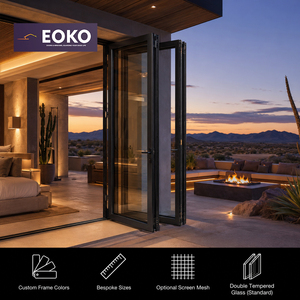
EOKO Cold Climate Series Alpine Resort Panoramic Mountain View Thermal Break Insulated Aluminum Folding Door
Polyamide Strip PA66
U-Value ≤ 1.2 W/m²K
Triple Glazed
Configured for structural load stability, weatherproofing, acoustic insulation, and seismic resistance in high-end residential, resort, and commercial developments.
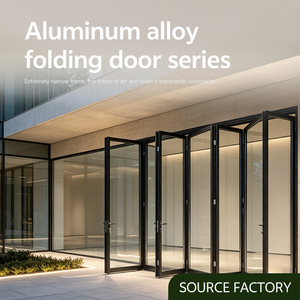
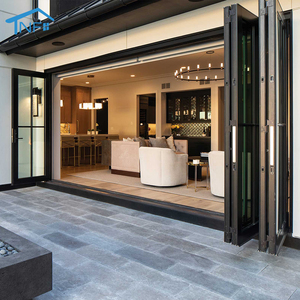
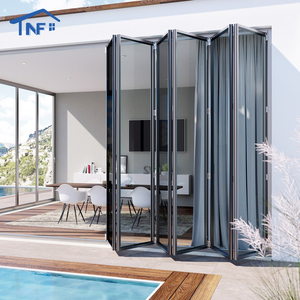
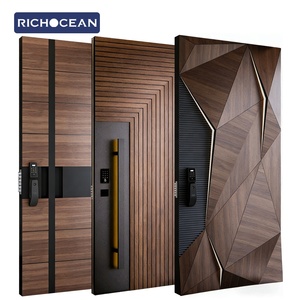
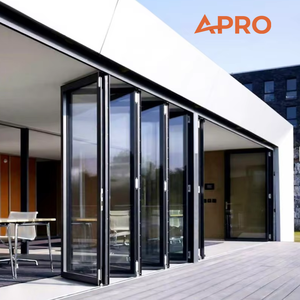
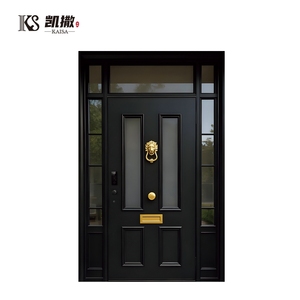
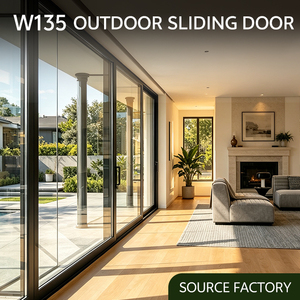
In high-specification commercial and residential developments, specifying exterior aluminium folding doors (commonly referred to as bi-fold, concertina, or accordion doors) demands precise engineering far beyond simple aesthetics. Unlike static curtain walls or standard sliding systems, bifolding doors operate under dynamic multi-axial loads. Each sash transfers dead load, live wind pressure, and operational torsional forces along a suspended head-track or bottom-rolling threshold. Ensuring decade-long effortless gliding without structural deflection requires an in-depth understanding of profile metallurgy, thermal boundary separation, gasket vulcanization, and stainless steel bogie carriage mechanics.
At Guangdong Dejiyoupin Doors and Windows Co., Ltd. (DERCHI), our OEM and ODM manufacturing pipelines leverage primary aerospace-grade 6063-T5 and 6063-T6 architectural aluminium alloys. Extruded with a uniform wall thickness ranging between 2.0 mm and 3.0 mm for heavy-duty structural mullions, these profiles resist high wind load deflection (Deflection Class deflection limit L/175 according to AS2047 and ASTM E330 testing standards). To conquer thermal bridging—an absolute imperative for climate zones ranging from sub-zero Alpine retreats to scorching 55°C Gulf desert environments—our thermal-break aluminium systems incorporate precision-crimped PA66-GF25 (25% glass fiber reinforced polyamide) thermal barrier strips. This structural configuration isolates the exterior ambient temperature from interior conditioned environments, preventing condensation, mitigating energy loss, and driving whole-assembly U-factors below 1.2 W/m²K when combined with low-emissivity argon-filled insulated glass units.
| Engineering Parameter | Commercial Grade Standard | DERCHI High-Performance OEM/ODM Specification | Project Compliance Standard |
|---|---|---|---|
| Aluminium Alloy & Temper | Recycled 6063-T5 (1.4 mm - 1.6 mm) | Virgin Primary Ingot 6063-T6 (2.0 mm - 3.0 mm structural walls) | GB/T 5237, EN 755, ASTM B221 |
| Thermal Transmittance (Uw) | 2.4 - 3.2 W/m²K (Non-break or basic) | 0.85 - 1.20 W/m²K (Multi-chamber PA66-GF25 + Warm-edge spacers) | NFRC 100/200, ISO 10077-1, Energy Star |
| Structural Wind Load Resistance | 1200 Pa - 1600 Pa (Class 2 / 3) | Up to 4500 Pa (Class 5 / Serviceability & Ultimate Limit State) | AS2047-2014, ASTM E330, BS EN 12210 |
| Acoustic Attenuation (Rw/STC) | Rw 28 - 32 dB | Rw 38 - 45 dB (Laminated acoustic acoustic interlayer + Dual-seal EPDM) | ISO 10140-2, ASTM E90 |
| Hardware & Roller Cycle Life | 10,000 cycles (Nylon wheels) | 100,000+ continuous cycles (Precision CNC SUS304/SUS316 Quad-Rollers) | EN 13126-15, AAMA 910 |
| Air / Water Tightness | Air: Class 2 / Water: 300 Pa | Air: Class 4 (≤ 0.5 m³/h·m) / Water: 700 Pa - 1050 Pa (Cascaded weepage) | EN 12207 / EN 12208, AAMA/WDMA 101 |
Equally vital is weather-sealing integrity. Standard PVC seals degrade and become brittle under prolonged solar ultraviolet radiation. Our manufacturing specifications mandate cellular co-extruded EPDM (Ethylene Propylene Diene Monomer) vulcanized gasket systems with continuous vulcanized corner boots. Coupled with our patented Four-Side Six-Point perimeter locking gearboxes, the panels achieve compression hermetic sealing against gale-force rainstorms, desert sandstorms, and urban noise pollution.
The international market for architectural aluminium fenestration is undergoing rapid structural evolution. B2B procurement professionals, EPC general contractors, and fenestration distributors are shifting procurement priorities based on three dominant secular macro-trends:
With the European Union Carbon Border Adjustment Mechanism (CBAM) and strict North American LEED v4.1 Platinum benchmarks, tier-1 developers mandate documented Environmental Product Declarations (EPDs). Procuring aluminium refined via hydroelectric or renewable power with certified scrap recycling chains has transitioned from an optional virtue to a contractual prerequisite.
Modern luxury villas and panoramic hospitality designs require minimal visual profile interruption. The procurement demand for ultra-narrow interlocking stiles (down to 25 mm - 45 mm visible width) capable of carrying single glass panel weights exceeding 350 kg is expanding at over 14.8% CAGR. This requires precision structural finite element analysis (FEA) to eliminate sagging.
Future-proof projects are abandoning stand-alone mechanical latches. OEM supply contracts increasingly specify concealed low-voltage brushless DC servo motors for automated opening sequences, integrated micro-switch magnetic contacts wired to Building Automation Systems (BMS), and biometric access handles certified against forced entry.
Furthermore, supply chain resilience is dictating international purchasing behaviors. In an era marked by shifting shipping routes, volatile ocean freight, and geopolitical uncertainties, importers are establishing long-term strategic relationships directly with comprehensive extrusion-to-finishing conglomerates. Manufacturers possessing in-house powder coating lines, automated CNC machining centers, and localized laboratory test chambers provide predictable project lead times and uniform batch quality.
From our headquarters in Foshan—the world’s industrial epicenter for architectural aluminium processing—we support developers, architects, and brand holders across North America, Europe, Australia, and the Middle East.
Equipped with German and Italian multi-axis automated CNC profile machining centers, fully automated robotic glass sealant lines, and dust-free assembly bays, ensuring annual output exceeding 1,000,000 square meters with zero-defect dimensional precision (tolerance within ±0.2 mm).
Full compliance coverage for all global major construction codes: certified under CE (EN 14351-1) for the European Union, NFRC and Energy Star for North America, AS2047 and AS1288 for Australia/New Zealand, and stringent Hurricane Impact Testing (ASTM E1886/E1996 & TAS 201/202/203).
Our engineering team drives proprietary innovation, including our world-renowned Four-Side Six-Point Anti-Theft Lock, concealed bottom-track self-clearing siphon drainage, and reinforced thermal break cold-bridge prevention chambers. Recognized by Xinhua News Agency as an industry benchmark.
Full bespoke design capability covering structural die fabrication, profile extrusion shapes, surface finishes (AkzoNobel Interpon D2525 powder coating, PVDF fluorocarbon 3-coat, deep anodizing up to 25 microns), custom laser branding, and complete architectural shop drawings (DWG/BIM).
Raw material spectrographic metal analysis, coating film adhesion cross-cut testing, sealant peel tests, 100% pre-assembly shop dry-hang testing before crating, and multi-stage crating in moisture-proof vacuum wrap with steel-banded fumigated plywood crates.
Over 18,000 successfully completed landmark projects worldwide spanning luxury residential estates, coastal oceanfront resorts, and premier hospitality clients such as Hilton and Atour Hotels. Seamless door-to-port and door-to-jobsite logistics management.
Clear, technically rigorous answers addressing thermal engineering, mechanical loads, shipping safeguards, and custom tool development.